Introduction:
- One of the most crucial steps in Pinterest affiliate marketing is selecting the affiliate product. Pins are designed to drive traffic and SEO descriptions can, but don’t necessarily, lead to sales.
- Not all popular items will be profitable. Some products attract attention but generate few sales, while others with moderate search interest may have stronger buying potential. The idea is to identify products to create content around first, before investing time in them.
- One of Pinterest’s greatest strengths is that users come to the site looking for ideas, products, styles, and solutions, making it a great place to conduct research. Pinterest says it is a place where people discover, plan and shop. (Pinterest)
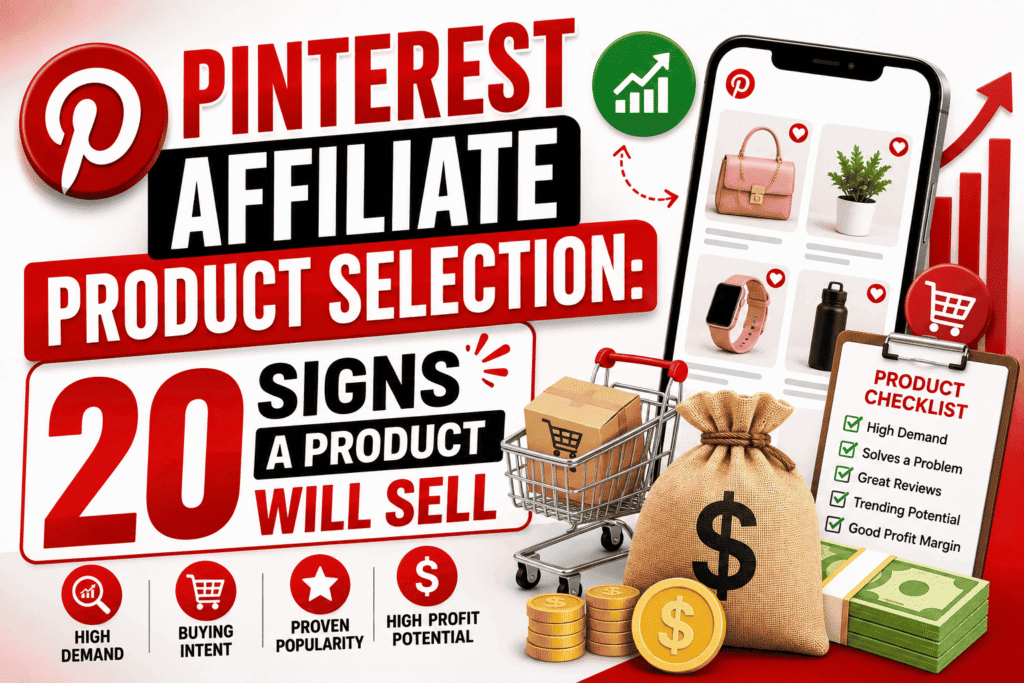
- With that in mind, here are 20 signs to use when deciding whether a Pinterest affiliate product has selling potential.
- In this blog, you’re gonna learn “Pinterest Affiliate Product Selection: 20 Signs a Product Will Sell”.
1. Search Interest Is Increasing:
- One of the signals is an increase in search interest. When the product or keyword search volumes continue to rise, it means more people are interested in the product.
- Don’t pay attention to search volume. Check the direction of the trend. An upward-moving product can provide more opportunity than a downtrending product.
2. The Product Appears in Pinterest Trends:
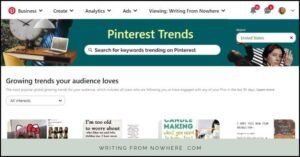
- Use Pinterest trends to know what keywords and topics are trending. Another piece of useful information for marketers is that Pinterest can deliver shopping-trend data, which can guide marketing teams in determining which product categories are gaining traction. (Pinterest)
- If a product is associated with an emerging trend, it should be researched.
- 3. People Are Saving Related Pins
- Saves are useful as they may mean that the user has deemed an idea substantial enough to save for future use.
- When you need to research a topic for an affiliate, go beyond one Pin. Verify if Pins related to the product, category or use case are getting saved.
3. The Product Has Strong Visual Appeal:
- Pinterest is a visual discovery platform, so products that appear good in photos or video will have an edge.
- Home decor, fashion accessories, beauty items, organizers, gadgets, crafts or lifestyle items can be a great fit if they can be shown in a picture.
4. The Product Solves a Clear Problem:
- Products that can fix a problem can have buying intent.
- For instance, a storage product resolves a problem of an organization and a travel organizer resolves packing issues. What is the problem does it solve, and can I write one sentence or more about what is the problem?
- The more straightforward the answer, the easier it is to make affiliate material.
5. The Product Has Multiple Use Cases:
- A product is more interesting if it can be used in multiple situations.
- For instance, an organizer could be involved with a bedroom bag, office bag, kitchen bag or a travel bag. Being able to create multiple use cases provides you with multiple chances to create Pins and blog articles based on the same affiliate product.
6. There Are Multiple Keywords:
- Ideally, a strong product should have search terms that relate to it.
- You could find some related searches such as packing cubes, luggage organization, suitcase storage, travel accessories, or packing tips among the different search terms you can find under the “find travel organizer” search.
- The more variations of the keywords you have, the more chances you’ll have for content.
7. People Are Comparing Similar Products:
- Comparison behavior can actually be a buying signal!
- Pinterest users who are looking for phrases like “top,” “versus,” a “review,” or “alternative” may be further along in their journey than discovery—they are likely closer to a purchase.
- This can be the basis for comparison articles and affiliate guides.
8. The Product Is Easy to Demonstrate:
- Candidates for Pinterest are products that can be demonstrated through before-and-after photos, tutorials, demonstrations or step-by-step information.
- For instance, an organizational product can be displayed before and after its use. A beauty tool can be demonstrated through a tutorial. A product used in a recipe or preparation process may be a kitchen product.
9. The Price Is Reasonable for the Audience:
- Price has an impact on decision-making.
- People often need to trust and research costly products before they make a purchase. Low-cost products might result in commissions that are not worth your while.
- Check the products that have a fair price for the audience you are targeting and a high enough affiliate commission to make the promotion worthwhile.
10. Affiliate Commission Is Attractive:
- Potential sales are not sufficient. Commission should also be taken into account.
- A product that sells regularly but offers a commission may not be as beneficial as a product that isn’t sold as often but offers much higher earnings per sale.
- Make money calculations before buying the product.
11. The Product Has Good Images:
- The key to Pinterest affiliate marketing is presentation.
- If the merchant does high-quality product photography, you may have material to work with when you create your content, as you will have some great lifestyle pictures and product information.
- The product information, strong titles and descriptions, availability, pricing and images are also highlighted as basics for shopping performance in the current Pinterest shopping guidance. (Pinterest)
12. The Product Fits a Specific Pinterest Niche:
- The product must relate to your current audience.
- For instance, if you’re in the field of fashion, you could sell accessories on your Pinterest while a home decor store might target organization products and fancy items.
- If you have a niche, it will be easier to get visitors rather than having to gather any clicks.
13. The Product Matches Seasonal Demand:
- Certain products are much more appealing for certain seasons of the year or events.
- Demand can fluctuate for holiday, summer, back-to-school items, travel, winter clothing and more.
- The calendar is a key element of Pinterest’s 2026 marketing guidance. Life events are events to focus on planning content and campaigns. (Pinterest)
14. The Trend Has Room to Grow:
- Don’t wait until all the competitors are selling the product.
- An emerging trend can be a good opportunity to publish content before seasons are ramping up. For instance, Pinterest Predicts 2026 is a suite that detects emerging trends using big data from search and engagement, and analyzes them. (Pinterest)
- This is the best time to find a product with a rising interest in it before it becomes popular.
15. The Product Has Repeat-Purchase Potential:
- Repeat purchases can be created by some products, possibly resulting in affiliate opportunities.
- There may be more than one buying opportunity for consumable products, replacement items, accessories and products with components.
- When thinking about repeat purchases, always read the affiliate program’s commission policy first to ensure that you are not expecting commissions for purchases you make that are not covered.
16. There Are Complementary Products:
- The more natural the connection of a product with other products, the more valuable it is for content creation.
- For instance, a travel bag could go with packing cubes, organizers, luggage accessories and travel gadgets.
- There is no need to rely on one product page to create product lists, product bundles, product comparisons, and product-related articles.
17. The Product Has Strong Buying Intent:
- Popularity is not the key factor; it’s search intent.
- If you’ve been looking for “home decorating ideas,” you might still be out there. The person who typed in ” wall organizer for bedroom” is looking for something that is more specific and is a step closer to buying it.
- Focus on keywords that suggest people are researching, comparing, looking for solutions or planning to purchase affiliate products.
18. Multiple Data Signals Agree:
- High performance generally doesn’t rely on any particular metric.
- Several signals in conjunction make a product more promising:
- Users are interested in searching.
- Saves are applied to Related Pins.
- The product is aesthetically pleasing.
- Users are deciding between options.
- The product provides a solution to a problem.
- The price is not too high.
- The affiliate commission is worthwhile.
- The product is suitable for the niche.
- It is supported by seasonal or trend-based demand.
- The merchant has a reviews section.
- That’s where a data-driven decision-making process comes in. Do not ask the question, “Is this product popular?” Ask, “How many independent sources of information do you have that people want this product?
- For those who are new to Pinterest, the process of getting a Pinterest Affiliate Product is not that complicated.
- A scoring system may be developed before promoting a product.
- Assign a score to each of the 20 signs (0-5):
- 0 = No evidence
- 1 = weak
- 2 = Weak
- 3 = Moderate
- 4 = Strong
- 5 = strong
- A product with high ratings in multiple metrics should be given more consideration than one that achieves very high ratings based on one metric.
- For instance, a product that is appealing but has lower search volume would not be as desirable as a product that is only moderately appealing, but has higher search volume, strong reviews, good commission potential, and good buying intention.
Final Thoughts:
- The best thing about making a Pinterest affiliate choice is not about trying to predict what product will go “viral” and “trending.” It’s an exercise in gathering evidence and pattern recognition.
- Ideally, the best opportunities are those that have growing interest appeal, easily identifiable problem-solving value, keyword relevance, buying intent, reasonable pricing, good customer reviews, and profitable affiliate/earnings value.
- This kind of data-oriented research is becoming more possible thanks to Pinterest’s current shopping and trend tools, which enable marketers to go beyond popularity and look into what is happening on the demand side of Pinterest. (Pinterest)
- When you’re considering promoting any product, assess it by the 20 signs outlined above. The more signals that align with your case, the more you’ll be able to create Pins, blog posts, comparisons and affiliate content about that product.
Keep in mind: popularity on Pinterest isn’t the only thing that matters for a product to sell. It must be delivered to the audience when and must have a convincing reason to buy when it is delivered.