Introduction:

- At first, it may seem easy to select an affiliate product for Pinterest. You discover something that appears popular, produce a Pin and add your affiliate website link. However, the popularity of a product doesn’t necessarily mean that people will click on it or purchase it.
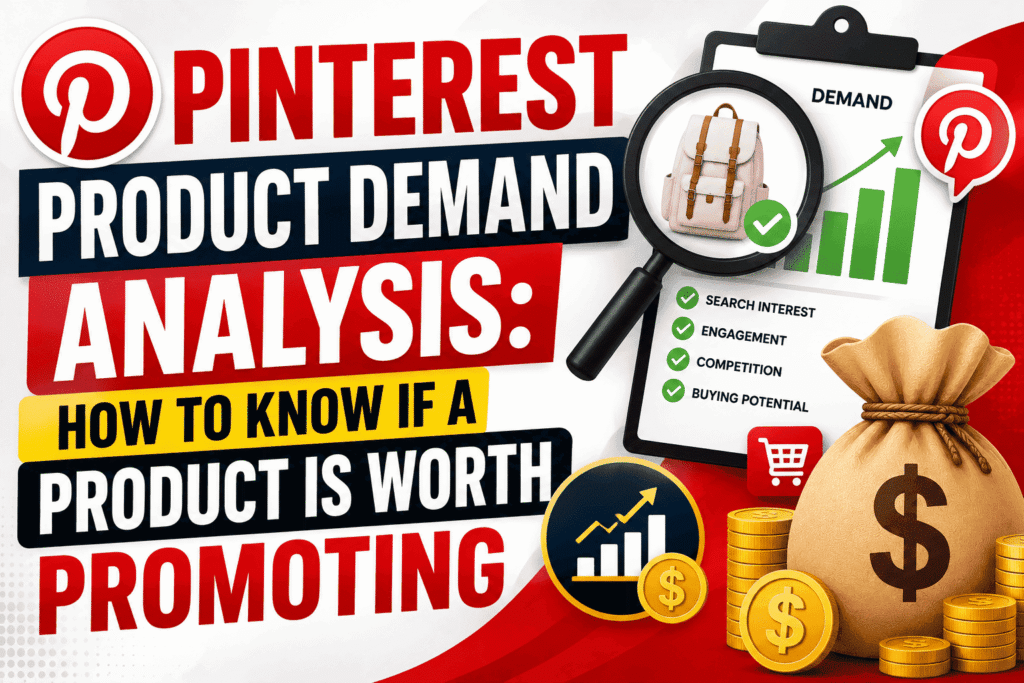
- A product can be highly visible while another less visible product may get more interest from the right audience. That is why it is beneficial to perform a Pinterest product demand analysis. You can do some research before investing your time into making Pins to see what people are searching for, saving and shopping for. You can also look at competition, seasonality, buying intent and the earning potential of the product. These signals provide much better information about whether a product is worth testing.
What Is Pinterest Product Demand Analysis?
- Pinterest product demand analysis is simply the process of checking the level of interest in a product or a product category before promoting it.
- The aim isn’t to find the product with the maximum number of views. You need something actually interesting to the audience that provides useful content opportunities and shows at least some signs of real interest in the product.
- There are tools on Pinterest that may assist with this research. The Trends platform can be used to see popular keywords and Pinterest also offers insights into shopping trends. This can help marketers understand which products and categories are getting attention.
- This is a better place to begin than simply choosing a product because you see it repeatedly on your Pinterest feed.
Start by Checking Pinterest Search Demand:
- One of the first things that I would look at is search demand.
- Consider what your search query would be on Pinterest if you were looking to purchase something. A broad keyword like “home decor” can tell you that the category is interesting but it doesn’t tell you exactly what people are looking for.
- Instead, you can try searching for specific queries like:
- Small bedroom decor
- Minimalist desk accessories
- Kitchen organization products
- Bathroom storage ideas
- Small apartment furniture
- These searches can provide you with hints about the problems people are trying to solve or the products they may be considering purchasing.
See Stable or Growing Interest:
- Don’t rush toward a product just because you see one big spike in interest.
- Suppose Product A suddenly becomes popular but the demand decreases after a few days. Over a longer period, there is steady interest in Product B. I would generally be more interested in researching Product B because it isn’t completely dependent on one short-term trend.
- However, a fast-growing product shouldn’t be ignored. Sometimes that’s exactly where a good opportunity begins. The key is to see if the increase is meaningful and if people are still interacting with related content.
Don’t Judge the Book by Its Cover:
- While impressions can certainly make a product look impressive, you can’t tell everything from impressions alone.
- Another useful indicator is saves. Saving a Pin means someone wants to keep that idea for later. That’s useful because Pinterest can be a place for planning purchases, projects, outfits and trips, which people don’t necessarily decide to do immediately.
- Think about two products. One gets 50,000 impressions but very few saves. The other receives fewer impressions but people save the related Pins more often.
- The second product might be worth researching further because it appears that the audience is more interested in keeping the idea for later. But having more saves still doesn’t guarantee sales. It simply gives you another useful signal when you’re evaluating a product instead of judging it only by views.
Investigate Shopping Trends and Related Products:
- When you come across a product that you like, don’t stop there.
- Examine the broader category and other related products. Use Pinterest’s shopping trend data to explore shopping categories and related interests.
- When you’re considering a product for promotion, such as a desk lamp, you might also research:
- Home office accessories
- Desk organization
- Study room products
- Desk decor
- Workspace lighting
- You may find another product with more demand or discover that there are better content angles around the category.
- That’s why it’s useful to research a particular product category before selecting a specific affiliate product. It gives you additional choices instead of limiting yourself to one item.
Pay Attention to Buying Intent:
- A product can have a lot of Pinterest interest without having strong purchase intent.
- Compare these searches:
- Informational: “Bedroom ideas”
- Commercial: “Best bedroom lamps”
- Product-focused: “Modern bedside lamp”
- From the first search, it appears that the person is still collecting ideas. The second suggests that they’re looking at products and comparing their options. The third is much closer to someone searching for a specific product.
- For affiliate content, the last two can be particularly interesting because the person may already be closer to making a buying decision.
- Broad keywords aren’t useless, though. They can help you connect with people earlier in the process and give you opportunities to present products naturally.
Before Investing, Determine the Seasonality First:
- Certain products aren’t always popular throughout the year.
- Examples include Christmas decorations, wedding products, graduation items and summer travel accessories. Demand for these products can change depending on the season.
- Rather than treating seasonality as a problem, use it to plan your content.
- If you’re aware that a certain product usually reaches peak demand around Christmas, you don’t want to create your Pins after the popularity has already started falling. You want your content ready while people are beginning to search and plan.
- Interest in certain trends can also build and peak at specific moments. Pinterest provides trend data for these moments, which can help you understand when interest begins and when it reaches its strongest point.
Use Emerging Trends as Research Clues:
- One more place to check when considering new product opportunities is Pinterest Predicts.
- Pinterest’s 2026 report includes 21 emerging trends across categories such as fashion, beauty, food and decor. Pinterest says its predictions are based on billions of searches and visual engagement signals, along with machine learning and predictive analytics.
- You don’t have to promote a product just because it appears in one of these trends.
- Instead, treat the trend as a research clue.
- If a trend is related to home decor, for example, you can research the related products, check Pinterest interest and then see if suitable affiliate programs are available.
- This is a more careful way to approach emerging trends rather than assuming every forecasted trend will become a successful product.
Study the Competition:
- You also need to understand what you’re competing against. Search your target keyword on Pinterest and look at the Pins that already appear.
- Pay attention to:
- Quality of the images
- Product presentation
- Titles
- Descriptions
- Keyword usage
- Content formats
- Number of strong competitors
- Engagement signals
- A competitive keyword isn’t always a bad choice. Sometimes you simply need a more specific angle.
- For instance, the term “shoes” is very general. A topic such as “comfortable walking shoes for travel” gives you a better idea of who your audience is and gives you a more specific topic to create content around.
Check the Product’s Affiliate Potential:
- There is another factor you shouldn’t overlook.
- A product can have great demand and still be a poor affiliate opportunity.
- Before promoting it, you should research the product price, commission rate, commission rules, cookie duration, merchant reputation, reviews, shipping options and return policies. Also consider whether the product actually fits the audience you’re trying to reach.
- A low-priced product may be easier for people to purchase but the commission could be small. A higher-priced product may offer a better commission but it can also require more trust from the buyer.
- You’re not simply looking for the product that pays the highest commission. You’re looking for a reasonable balance between demand, product quality, buying potential and earning potential.
Develop a Simple Product Scoring System:
- When you’re looking at several products, you can make the research process easier by using a simple scoring system.
- Give each product a score from 1 to 5 for:
- Search demand: Is search interest stable or rising?
- Save potential: Are people saving related content?
- Shopping interest: Is there commercial interest?
- Purchase intent: Are people looking for specific products?
- Competition: Do you have a realistic chance to compete?
- Seasonality: Do you understand the product’s demand cycle?
- Commission potential: Is the commission worthwhile?
- You don’t need to score 5 in every category. The goal is to make a more objective decision when comparing different options rather than picking something simply because you personally like it.
Test the Product Before Scaling:
- Research can help you make a better decision but it can’t guarantee that you’ll make a sale.
- After choosing a product that looks promising, create several Pins with different images, titles and content angles. Then look at the available data, including impressions, saves, outbound clicks and conversions.
- Pinterest says factors such as searches, saves, engagement, seasons, holidays, formats, language, location and trending topics can affect Pin distribution. Pins can also continue receiving engagement after they’re published.
- So don’t judge the entire product based on the first Pin. If one Pin doesn’t perform well, the product may not be the problem. Your image, keyword or content angle might simply need to be adjusted.
A Quick Product Demand Checklist:
- When looking to promote a Pinterest affiliate product, ask yourself:
- Do people search for this product consistently or is interest increasing?
- Are people saving related Pins?
- Is there shopping interest in the category?
- Are people looking for specific products?
- Is demand seasonal?
- Is the product connected to an emerging trend?
- Can I realistically compete?
- Does the product have a useful purpose and appear reliable?
- Is the affiliate program financially worthwhile?
- Can I create several useful pieces of content around it?
- If most of the answers are yes, the product could be worth testing.
Conclusion:

- Good Pinterest product research isn’t about chasing anything that looks like it’s going viral. It’s about understanding why people care about a product and whether that interest matches your audience.
- A strong opportunity usually has several factors working together: audience relevance, buying intent, content potential, competitive opportunity and affiliate earning potential.
- Before creating dozens of Pins for one product, take some time to evaluate its search interest, saves, related products, seasonal trends, competition and affiliate terms. You may discover that the product you initially wanted to promote isn’t actually the best choice for your website.
The most popular product isn’t always the one worth promoting. A better option can be a product where the right audience is interested and where you can create genuinely helpful content around it.